Block management software for block and estate management companies.
Service charges, compliance, repairs and leaseholder contact, kept in one record for each block. Built in the UK for managing agents working under English and Welsh leasehold law.
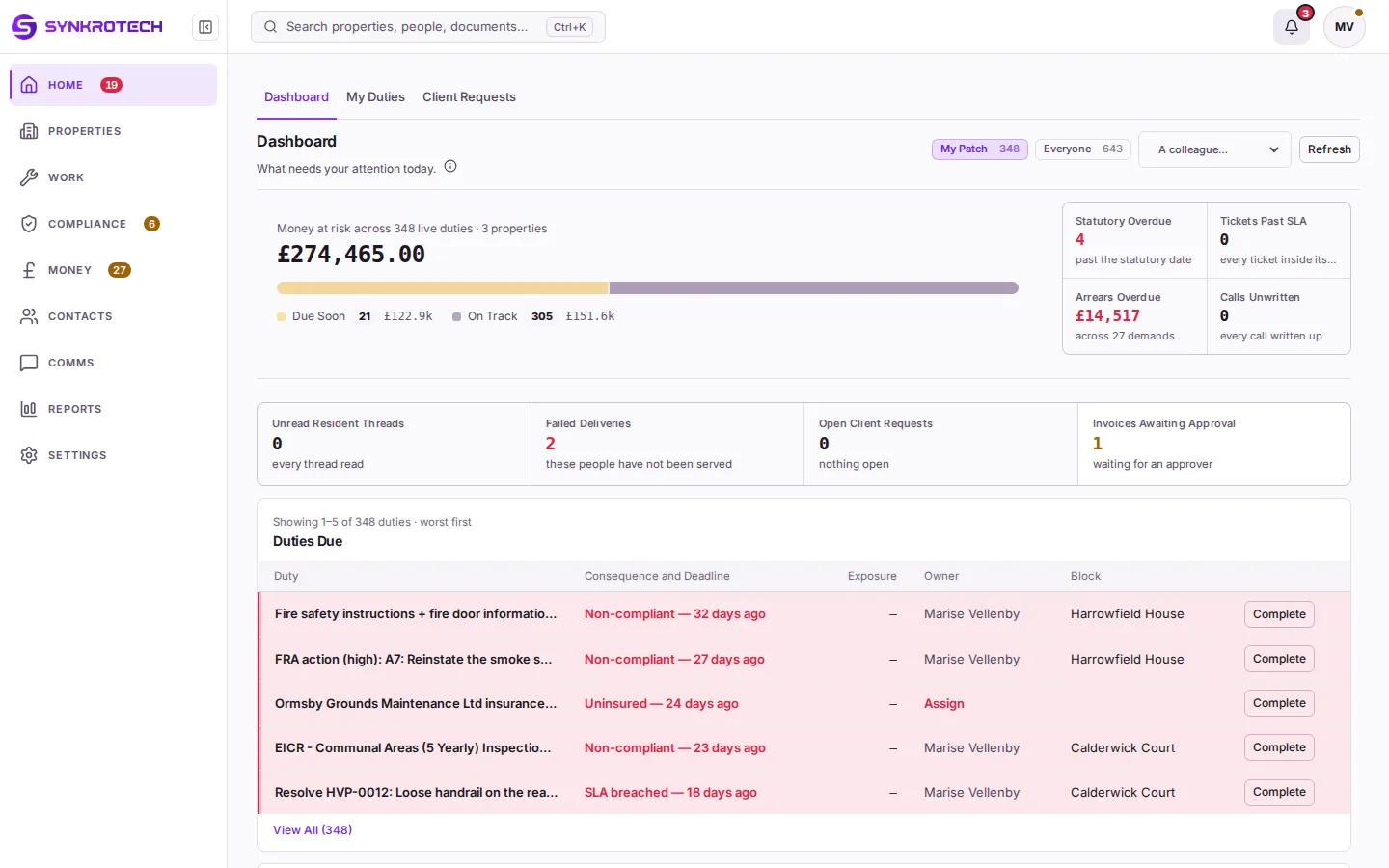
What a property manager sees at nine in the morning.
The buildings, people and figures in every picture on this page are a demonstration estate we made up. They are not any agency’s data, and they are not a result anybody has had.
What It Does
The overdue safety checks are the first thing you see.
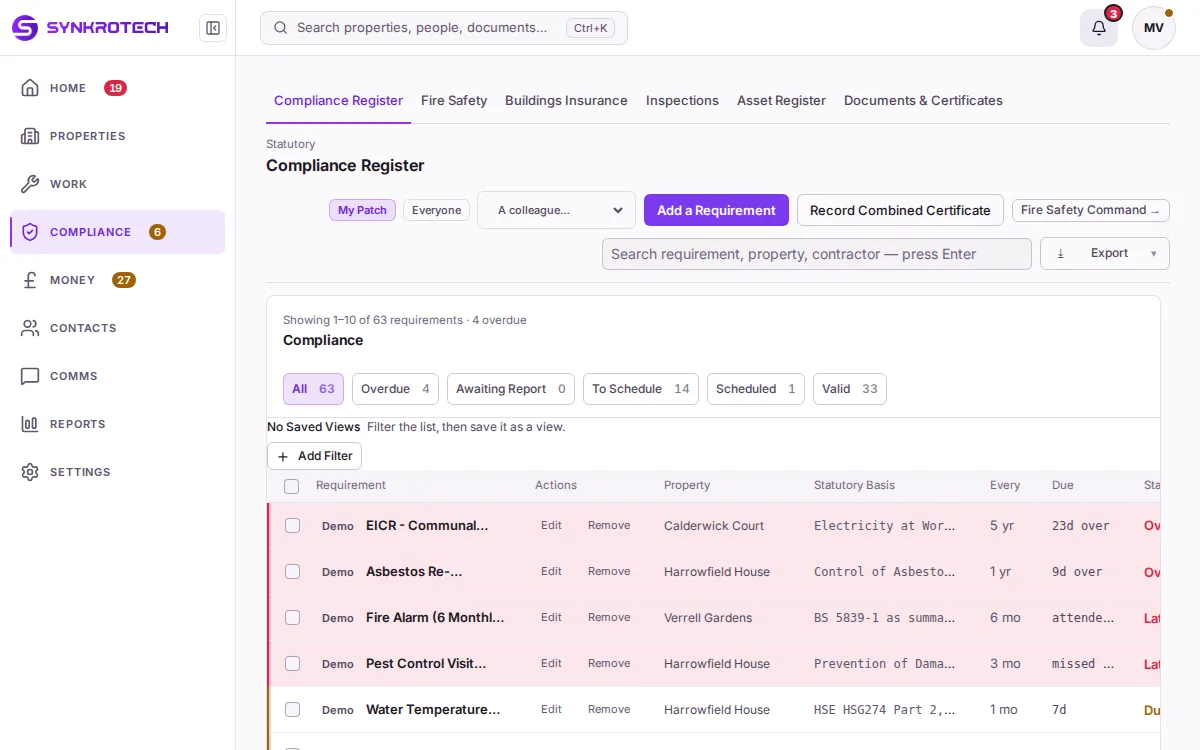
The register works out which statutory duties apply to each building — from its height, its plant and its records — and puts what is overdue at the top of your morning. Nobody types a due date for a fire risk assessment.
The compliance register, worst first, with the law behind each row.
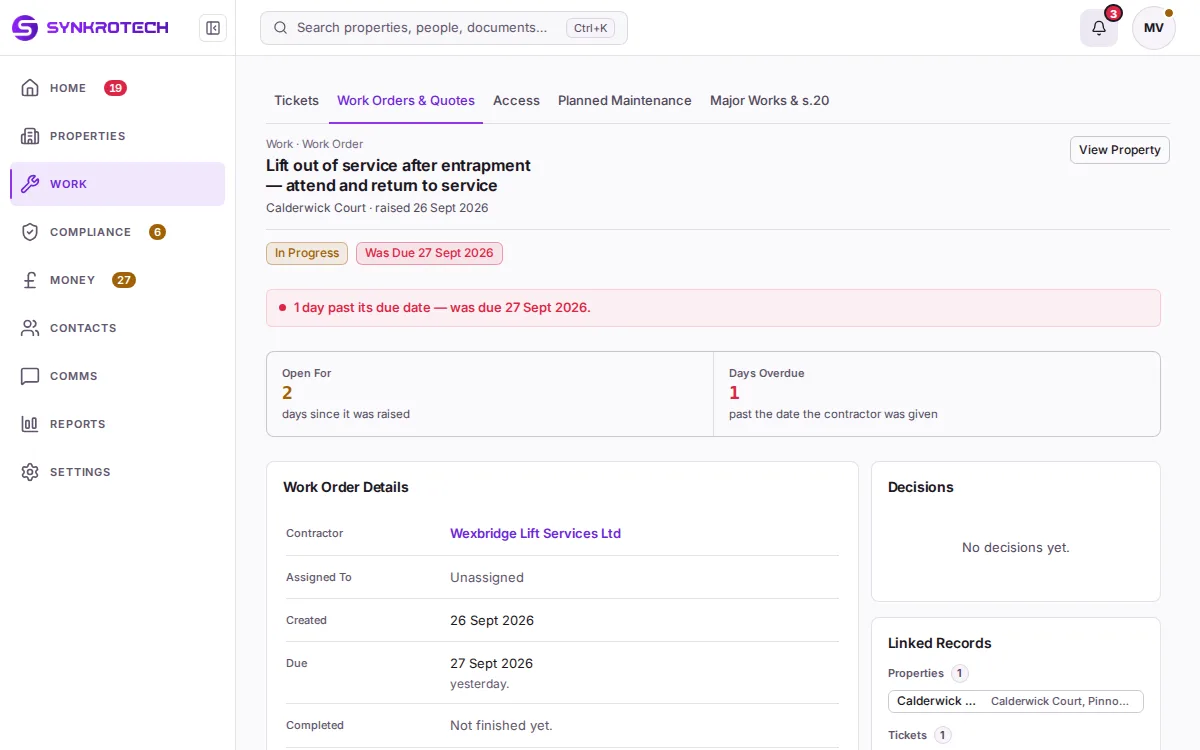
A report becomes a job, and the job goes to a firm, without retyping it.
What somebody reports on site becomes a ticket in one step; the ticket becomes a work order; the work order goes to a contractor whose insurance the system has already checked is in date. Everything it touches stays linked to it.
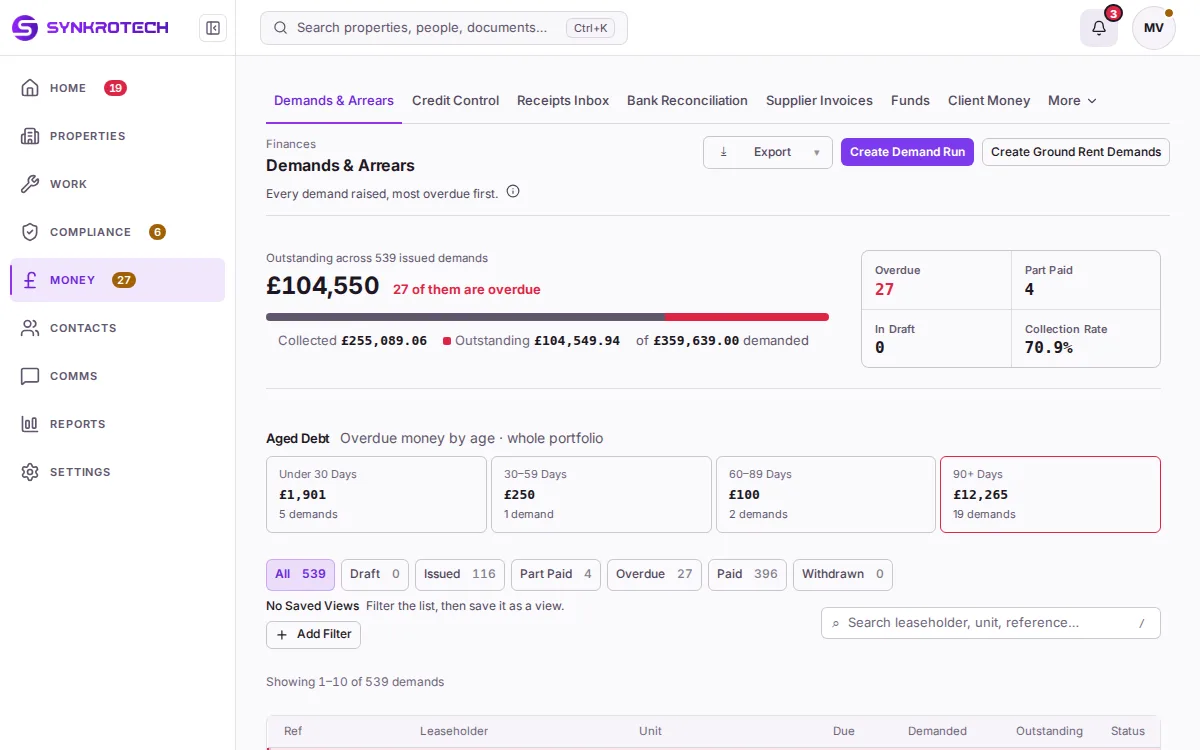
Service charges in whole pence, split by each lease’s own percentages.
Every amount is a whole number of pence and every share is set on the lease, so a block’s demands add up to its budget exactly. What was collected, what is outstanding and how old the debt is are on the same screen as the demands.
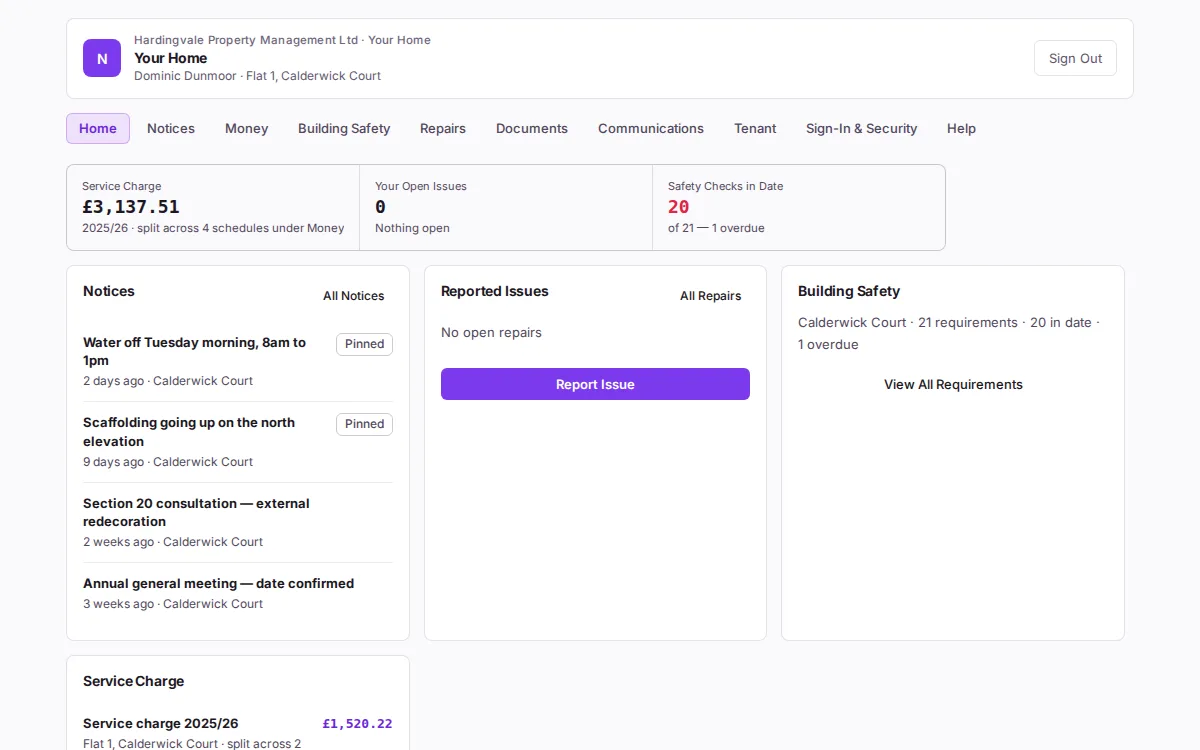
A leaseholder sees what they are charged, and why, on their own page.
Their charge for the year, the notices for their building and its safety record — including a check that is overdue. It is not a copy of the office’s data: it reads the same records, filtered to what that person is entitled to see.
A leaseholder’s own page — including the check that is overdue.
Who It Is For
Block and estate management companies: the managing agents who look after residential blocks for freeholders, resident management companies and right-to-manage companies. From one block to a whole portfolio.
What It Replaces
Most agencies run a block out of a spreadsheet, an inbox and a filing cabinet.
TodayWith SynkroTech
Today: The block's facts live in whoever's head — and their spreadsheet.
With SynkroTech: One record per block: every fact in one place, whoever is at the desk.
Today: A statutory check is remembered, or it is missed.
With SynkroTech: Duties are generated from the records, each with a date, an owner and what a breach costs.
Today: A demand goes out when somebody remembers to send it.
With SynkroTech: Every document out sits in one outbox, by the route each person asked for — email, print or post.
Today: The apportionment is a formula in a cell that somebody once got right.
With SynkroTech: Apportionments have to total exactly 100% before a budget will run.
Today: A leaseholder rings to ask what they owe.
With SynkroTech: They open their own portal and see it, and what it is for.
Six Ways In
Leaseholders, residents, directors and contractors each sign in to their own part.
A leaseholder sees their charges and their building’s safety record. A director of the company sees what the agent holds, in totals. A contractor sees their jobs. Nobody sees another’s.
Managing Agent Staff
The whole platform.
Leaseholder
Their charges and their building’s safety record.
Resident or Tenant
Their building’s notices and safety record, a communal issue to report, and parcels held at the desk.
Director of an RMC or RTM
What the agent holds, in totals.
Contractor
Their jobs.
Concierge or Porter
Parcels in and out, the flat directory and the resident thread, for one building — flats, with residents’ names only at hand-over.
Each member of staff connects their own mailbox, calendar and Teams chats. Nothing is read on anyone’s behalf.
Sign in with Microsoft or Google
Where the agency’s administrator turns it on, with two-factor authentication on top.
Sending email
Letters through a Microsoft 365 mailbox the agency names; group email through Postmark or Mailgun.
Printed post
Handed to a UK mail house and posted by Royal Mail. Nothing is marked posted until the mail house says so.
Xero
An approved supplier invoice goes to Xero as a draft bill, with a preview first.
Not Offered
Card and direct-debit payments. Leaseholders pay by bank transfer, quoting their demand’s reference.
What Is Included
One fixed monthly fee, scaled to the size of your portfolio.
We are setting our pricing with our first customers rather than publishing a figure we would have to walk back. Tell us how many units you manage and we will give you a fixed monthly number, in writing.
Every agency runs the same build. Your plan says which features are switched on for your organisation, and switching one on later is a change to your plan rather than a new install.
Two are always on, because nothing works without them: your properties, and your organisation’s own administration.
How many people can use it?
As many staff as your plan includes. A plan can set a limit on staff accounts, properties and storage, and the software counts each one against it; the figures are written into your quote.
Leaseholders, residents, directors, contractors and the concierge desk sign in through their own doors and are not staff accounts. What each member of staff sees is decided by their role.
Is the leaseholder portal included?
The portals are one of the features a plan switches on, and your quote says whether yours includes them. There are six ways in: the office, and the leaseholder, resident, director, contractor and concierge doors.
They are not a copy of your data, either. Each one reads the same records the office does, filtered to what that person is entitled to see.
Can I get my data out again?
Yes. Exports are typed — a spreadsheet arrives with dates as dates and money as money, not as text — and documents come out as letterheaded PDFs carrying your branding, or, where an editable copy is safe to give, as Word documents you can finish yourself.
The same is true on the way in: a portfolio loads from CSV with a dry run first, and nothing is written until you commit.
Where is it hosted, and who can see our data?
In the United Kingdom, on a server in London, with encrypted backups in the European Union. Each agency’s records are scoped to that agency at the database level, and a build-time test holds new tables to that rule — it fails the build if a query against one omits the agency.
Our own support staff cannot read your records unless your administrator grants support access, for a set time of up to 72 hours, and can revoke it at any time. The privacy notice sets out the detail.
The Next Step
We would rather show you the screen than describe it.
Tell us roughly how many blocks and units you manage. We will walk the product with your kind of portfolio in front of us, not a tour.